Automation & Robots
| Plant type | Industrial assembly facility |
|---|---|
| Original use | Manufacture of automated systems and robotic units |
| Primary output | Industrial robots and automation cells |
| Typical size | Large-scale industrial building complex |
| Key process | Robotic assembly and system integration |
| Supplier tier | Tier 1 (direct to OEM) or Tier 2 (to system integrator) |
| Common location | Industrial parks or manufacturing regions |
Origin and history
Automation and robotics in assembly plants trace their origins to the United States in the mid-20th century. The first significant implementation is widely considered to be the Unimate robot installed at a General Motors die-casting plant in New Jersey in the early 1960s. This innovation emerged from the convergence of post-World War II technological advances in computing, servo-mechanisms, and numerical control. The development was fundamentally driven by the automotive industry's pursuit of consistency and productivity in repetitive, hazardous tasks. The technology diffused globally throughout the 1970s and 1980s, with Japan and Germany becoming major centers for both adoption and further robotic innovation. The historical progression moved from simple, fixed-sequence mechanical arms to today's sensor-equipped, programmable machines capable of complex assembly.
What it was bred for
These systems were originally developed to perform tasks that were dangerous, monotonous, or physically demanding for human workers. The primary initial applications were in die-casting, spot welding, and machine loading and unloading within high-volume manufacturing, particularly automotive. They were bred for absolute consistency, performing the same motion thousands of times without fatigue or deviation, thereby reducing part variability. A core purpose was to operate in environments deemed unsafe due to heat, toxic fumes, or heavy payloads. The technology aimed to shield human workers from these hazards while improving the overall throughput and predictability of the production line. Later evolution focused on precision tasks like painting, sealing, and eventually intricate component assembly where minute, repeatable accuracy is paramount.
Life cycle
The life cycle of an industrial automation or robotic system begins with a lengthy planning, design, and integration phase, often spanning months or years to align with product design and factory layout. Following procurement and installation, a rigorous commissioning and programming period ensues, where the system is taught its tasks and synchronized with other equipment. The operational life, typically lasting one to two decades, involves continuous cycles of production runs, preventive maintenance, and occasional reprogramming for new product variants. Key phases within this period include scheduled servicing of mechanical components, calibration of sensors, and updates to control software. Degradation manifests as increased downtime, loss of positional accuracy, or obsolescence where the system cannot interface with newer technologies. Decommissioning involves disassembly, with components often recycled or repurposed, and the cell space is reconfigured for its successor system.
Character and appearance
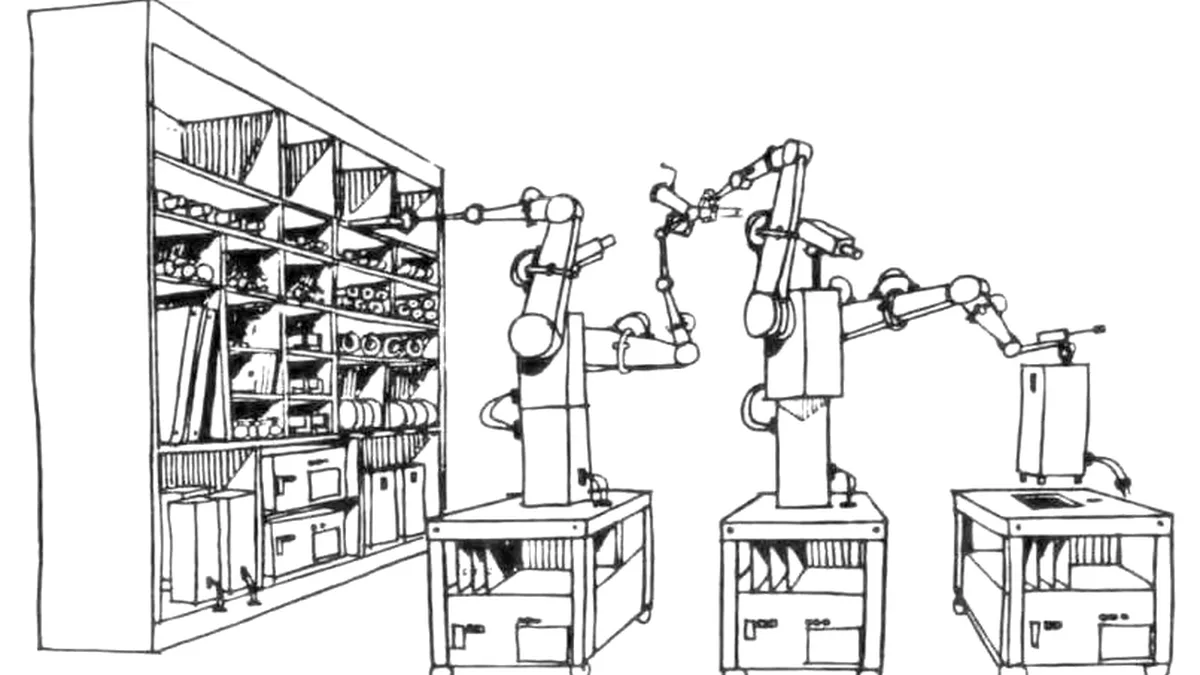
Industrial robots present a functional and engineered appearance, dominated by articulated arms with multiple axes of rotation, typically six, mounted on a fixed base or mobile platform. Their character is defined by precise, deliberate, and isolated movement within a safeguarded work envelope, often behind fencing or light curtains. The physical form is a blend of cast metal structures, servo motors at each joint, and a wrist featuring an end-effector or tooling specific to its task, such as a gripper, welder, or screwdriver. Ancillary automation, like conveyors, palletizers, or automated guided vehicles (AGVs), exhibits a more modular and linear character, designed for continuous flow. The overall impression is one of purposeful motion devoid of autonomy, entirely dependent on programmed instructions and sensor feedback. A cell's appearance is completed by a control cabinet housing the programmable logic controller (PLC) and power systems, with bundles of cables and pneumatic hoses routed along the arm.
Overview
Automation and robotics in an assembly plant context constitute an integrated system of machines, controls, and software that executes physical production tasks with minimal human intervention. This ecosystem extends beyond the final assembly line to encompass the supplier tiers, where robotic cells might manufacture and prepare sub-components for just-in-sequence delivery. The core function is to transform raw materials and parts into a finished product through a series of precisely choreographed operations like joining, fastening, dispensing, and inspection. It operates as a subordinate layer within the broader manufacturing execution system (MES), receiving work orders and reporting production data. The technology represents a capital-intensive transformation of the production process, prioritizing repeatability, speed, and integration over flexibility in its traditional forms. Its effectiveness is measured by uptime, cycle time, first-pass yield, and its impact on overall equipment effectiveness (OEE) for the line.
What to know
Successful implementation requires understanding that robotics are a single component within a larger system reliant on perfect part presentation and consistency; they cannot compensate for poor quality or variation in incoming components. Integration is a multidisciplinary challenge demanding expertise in mechanical engineering, electrical systems, software programming, and safety standards like ISO 10218 and RIA/ANSI standards. The total cost extends far beyond the robot purchase price to include end-of-arm tooling, safety fencing, sensors, programming, maintenance, and significant infrastructure changes. These systems create a shift in the human workforce, eliminating some manual roles while creating new demands for technicians, programmers, and maintenance specialists. Their programming is deterministic, meaning they only execute pre-defined logic and cannot adapt to novel situations without explicit sensor-guided instructions and error-handling routines. The technology locks in a specific process and product design, making late-stage engineering changes exceptionally costly and disruptive to implement.
Common questions
A common question is whether robotics directly lead to fewer human workers, though the reality often involves a reallocation of labor from direct, repetitive tasks to indirect, technical support and oversight roles. Many ask about the return on investment timeline, which is highly variable but typically calculated over several years based on labor cost savings, quality improvements, and increased output capacity. People frequently inquire about the ability of robots to work collaboratively alongside humans without safety cages, a capability now possible with newer collaborative robots (cobots) that have force-limiting designs and advanced sensors. A persistent question concerns flexibility, as traditional industrial robots are notoriously inflexible once programmed for a specific task, requiring significant time and cost to redeploy for a new product. Organizations often question how to choose between different robot types, such as SCARA, Cartesian, or articulated arms, a decision driven by required reach, payload, precision, and the nature of the task. There is also frequent discussion about the need for specialized in-house expertise, which is absolutely critical for sustaining operations and troubleshooting outside of vendor support contracts.
Pros and cons
A significant pro is the achievement of superhuman consistency and quality, eliminating variations caused by human fatigue or technique, which directly reduces scrap and rework. These systems provide a major advantage in throughput, operating continuously through breaks and shifts, thereby increasing overall plant capacity and output. They excel at performing dangerous tasks, improving workplace safety by removing personnel from hazardous operations involving heavy loads, toxic substances, or repetitive stress injuries. A primary con is the enormous upfront capital expenditure and the long, complex integration period that can disrupt existing production before delivering benefits. They introduce profound rigidity into the manufacturing process, making it difficult and expensive to accommodate product design changes or to switch production to a different item. A common mistake is underestimating the ongoing costs and specialized skill requirements for maintenance, programming, and troubleshooting, leading to extended downtime when the single expert is unavailable.
Who it suits
This technology best suits high-volume, low-mix manufacturing environments where a single product or variant is produced in massive quantities for years, allowing the high investment to be amortized. It is ideal for companies with stable, well-defined processes and component designs, where the task sequence and part geometries will not change frequently. Organizations with the internal engineering capability to support, integrate, and maintain complex electromechanical systems are strong candidates, as reliance solely on external integrators can be costly and slow. It suits operations where product quality is critically dependent on repeatable precision or where the manufacturing process involves significant ergonomic or safety risks for human workers. It is less suited to job shops, prototyping facilities, or industries with rapid product lifecycles where flexibility and quick changeover are more valuable than sheer throughput and consistency. Manufacturers with unstable or highly variable incoming part quality will struggle, as automation systems lack the adaptive problem-solving skills of a human operator to compensate for defects.